Your daily dose of Chicano poetry
"I write poems on walls that crumble and fall
I talk to shadows that sleep and go away crying.”
Luis Omar Salinas (1937–2008)
Gregg Barrios Review: Latinos in Lotusland
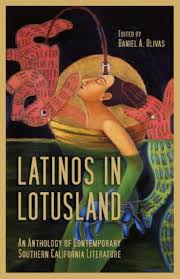
Latinos in Lotusland: An Anthology of Contemporary Southern California Literature
Edited by Daniel A. Olivas
Bilingual Review Press, $20 paperback, $30 hardcover
In citing the present Latino population of Los Angeles County at 4.6 million, the Los Angeles Almanac adds an arch footnote: “A late 19th Century editorial in the Los Angeles Times predicted that the ëMexican’ population in Los Angeles would disappear by the early part of the 20th Century.”
Latino writers might be hard-pressed to find solace in this. For in the world of mainstream publishing, they are still barely visible. And in the more rarified literary quarterlies and best stories anthologies, they are an endangered species.
Daniel A. Olivas edited this collection with this in mind. Yes, there is a respectful nod toward established and overlooked writers, but the lion’s share of its 34 stories comes from previously unpublished writers — some seeing their fiction, their byline in print for the first time.
Long overdue, “Latinos in Lotusland” is a literary GPS guide to El Pueblo de la Reina de Los Angeles, aka the city of Angeles as seen through Latino — mostly Mexican American and Chicano — writing.
And, oh, the places they will take you.
Among this reader’s favorites:
In Mario Suarez‘s “Kid Zopilote” (written in 1947), a Chicano youth leaves his home in Tucson, Ariz., for California and returns a zoot-suiter, a pachuco. Unlike Octavio Paz’s infamous essay on the pachuco, Su·rez accepts the Kid as an early clue to a new postwar order.
The Tucson police incarcerate the young pachucos, shaving their ducktails and shredding their threads. The action earns the approval of the Latino familias. “I am glad it happened to you,” The Kid’s mother gloats.
In “Daylight Dreams,” a Guatemalan immigrant smitten by a young woman on his daily bus ride finally gets the courage to talk to her. But fate steps in and the courtship is lost in translation.
In “Dia de las Madres,” an extended family bickers during a long ride with the dead mother’s ashes in the back seat. In “LAX Confidential,” a Mexican American Joe Friday comes face to face with the ghost of long-disappeared Chicano novelist Oscar Zeta Acosta.
A post-punk/slacker lifestyle fuels “Gina and Max,” while “Adriana,” with its Gloria Trevi/Chalino S·nchez bad-ass chola ‘tude echoes Michele Serros or Los Bros Hernandez in the barrios.
In “Act of Faith,” a woman on the verge declares her cheating husband dead. She buys a coffin with a papier-m‚chÈ figure and proceeds to have a wake and a body burning for the “deceased.”
“Ghetto Man” centers on 13-year-old homeboy Artie who channels his inner superhero by defending classmates against barrio and ghetto bullies. An epiphany of sorts occurs when a religion teacher asks him to explain the Holy Trinity.
” ëAt the end of Soul Train, Don Cornelius . . . always wishes everyone peace, love, and soul. And I think he’s talking about the Father, Son, and Holy Spirit.’ ”
“Cement God” is a paean to the generation that built their lives and homesteads through hard labor. When a young man asks, “Grandpa, who made the sidewalks?” He replies, “I did.” For the young man, his abuelo becomes a role model, a hero in his eyes.
This story dovetails with a chapter from Richard V·squez’s 1970 novel, “Chicano.” The excerpt focuses on a young cement worker as he joins the construction trade union to live his dream through hard work and in the pride he takes in the L.A. freeways and high-rises he helped build.
In “Driven,” two Southland strangers share a ride — each driven to find refuge or redemption in the nearby City of Angels: “Looking up, all I see are the smooth edges of skyscrapers sharp as blades cutting up the sky, the stars. The street names: Alvarado. Olive. First. Flower. I stick my head out the window. Catch a scent. A memory. A trace.”
“Latinos in Lotusland” is a movable feast that bears witness to the incredibly talented writers that reclaim Los Angeles as their own.
Gregg Barrios is an independent journalist and playwright who lives in San Antonio.
Artist Call: 2010 Festival de Flor Y Canto at USC
Reunion Artists
Poets, short fiction writers, novelists, and performers who participated in the 1973 Flor Y Canto, held in Los Angeles at the University of Southern California, are encouraged to return to USC for the 2010 renewal of this important event.
Click here if you participated in 1973.
New Work Artists
Poets, writers of any genre, and graphic and multimedia artists who work in Chicana Chicano Latina Latino traditions! The 2010 Festival de Flor Y Canto wants to showcase the growth and direction our work has taken since the landmark event of 1973.
Click here to participate in 2010.
Visit La Bloga for more details
The Raker
The Raker came and tossed my
carcass on the wagon
and rolled away
I stood next to you…still.
I heard you speak of power
structure in the East
And wanted only to touch
your face.
I asked if you were alive
And you replied that you
weren’t a sell-out,
Like McArthur you would return.
I was hungry beyond belief
And your fashionable Rebel
Rhetoric was your reply.
All the time we stood staring,
I was dying…
The Grim Reaper sharpened
his scythe,
You didn’t hear the noise and
spoke of being an Altar Boy.
I wanted to scream out for help,
But your ears had disappeared,
So the Grim Reaper succeeded.
The Raker came to take my
body away,
To toss it into the ditch
with all the other
victims of the Plague…
Gloria Guerrero
This poem is from the anthology El Quetzal Emplumece (published 1976) by the Mexican American Cultural Center, San Antonio
Featured Book: Chicano Sketches
This excerpt is taken from Suarez’s short story collection Chicano Sketches (2004) published by The University of Arizona Press
And El Hoyo is something more. It is this something more which brought Felipe Ternero back from the wars after having killed a score of Germans, with his body resembling a patchwork quilt. It helped him to marry a fine girl named Julia. It brought Joe Zepeda back without a leg from Luzon and helps him hold more liquor than most men can hold with two. It brought Jorge Casillas, a gunner flying B-24s over Germany, back to compose boleros. Perhaps El Hoyo is the proof that those people exist who, while not being against anything, has of yet failed to observe the more popular modes of human conduct. Perhaps the humble appearance of El Hoyo justifies the discerning shrugs of more than a few people only vaguely aware of its existence. Perhaps El Hoyo’s simplicity motivates many a chicano to move far away from its intoxicating frenesi, its dark narrow streets, and its shrieking children, to deny the bloodwell from which he springs, to claim the blood of a conquistador while his hair is straight and his face beardless. Yet El Hoyo is not the desperate outpost of a few families against the world. It fights for no causes except those which soothe its immediate angers. It laughs and cries with the same amount of passion in times of plenty and of want.
Mario Suárez
Some Conclusions
down the spiral column
that is my backbone, i
can feel successions
of vertebrae crack.
this osteal realization
leads me to conclusions
about my architectural
composition
i am not the atlas
though there is a world
of delicate balance
set up on this frame.
i am not ninety pounds
of weakness
but my strength is
born of fragile construction.
i am all,
flesh, and water, and bone.
i am an arrangement,
arrangement of the totality,
the totality of living matter.
within this expanding universe
that is me, there is also death.
a knowledge of so rare a dream
that often one does not acknowledge
its pulsating presence, partly
because its essence is
an ocean of silent emptiness.
Copyright 1977 Bernardino Verástique
from Yellow Luna


 Xican@ Poetry Daily