Your daily dose of Chicano poetry
"I write poems on walls that crumble and fall
I talk to shadows that sleep and go away crying.”
Luis Omar Salinas (1937–2008)

Pablo Bielli/Getty Images
Llosa.”
[Source: Los Angeles Times 05/19/09]
“Men like Mario never die,” Uruguay President Tabare Vazquez told reporters.
“When I have worries, fears or a love affair, I have the luck of being
able to transform it into a poem,” said Benedetti, the son of Italian
immigrants.
Little Stones At My Window
Once in a while
joy throws little stones at my window
it wants to let me know that it’s waiting for me
but today I’m calm
I’d almost say even-tempered
I’m going to keep anxiety locked up
and then lie flat on my back
which is an elegant and comfortable position
for receiving and believing news
who knows where I’ll be next
or when my story will be taken into account
who knows what advice I still might come up with
and what easy way out I’ll take not to follow it
don’t worry, I won’t gamble with an eviction
I won’t tattoo remembering with forgetting
there are many things left to say and suppress
and many grapes left to fill our mouths
don’t worry, I’m convinced
joy doesn’t need to throw any more little stones
I’m coming
I’m coming.
Indocumentada Angustia
by Lucha Corpi
Arpías insaciables
los rascacielos
consumiendo estrellas,
hartándose de luna,
encajonado al viento
que se venga
rompiendo flores y paraguas
y se contenta sólo
cuando su gran lengua transparente
conoce una vez más
la tiersa piel del agua.
Llega entonces la niebla
llena de tantas manos
y aves peregrinas,
corre entre las hojas pisoteadas
amortiguando queja y látigo,
acallando la indocumentada angustia
del ilegal en su propia tierra,
hundiendo sus dedos en la luna
y en la lejanía sin puertos
ni faros.
Find the English translation and a brief bio of Corpi at Unitedstatesean Notes
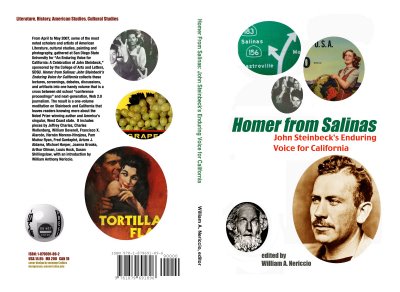
Tex[t]-Mex: Homer From Salinas: John Steinbeck’s Enduring Voice for California, a New Book from SDSU PRESS
William Nericcio has an upcoming book called Homer From Salinas: John Steinbeck’s Enduring Voice for California.
You can read the first few pages from the introduction here.
And if you haven’t already, check out Tex[t]-Mex: Seductive Hallucinations of the “Mexican” in America in which Nericcio “exposes, deciphers, historicizes, and ‘cuts-up’ the postcards, movies, captions, poems, and adverts that plaster dehumanization (he calls them ‘miscegenated semantic oddities’) through our brains.”
Cisneros talks Chicana literature
Identity Theft
If Artemio had any sense of identity,
it was buried in the deep past,
stone pyramids did not enter into it,
Mexican revolutions dead stadiums,
guerilleras not part of it either,
brazeros zilch, algodon cotton,
campesinos nel, chasing the crops
in canvas-covered trucks not important,
yet words of all sorts humbled him,
beckoned him, torn like a weed
from the ground, the weed clutching
the stony clods of dirt,
Artemio unknowingly accepted the air,
wore the sky like a shirt,
did not call the sun by its Aztec name,
gave it his own foul name,
gave everything a dirty name,
if Artemio had any sense of identity,
it lay within, and without—
sole surviving son of La pinche Malinche.


 Xican@ Poetry Daily