Your daily dose of Chicano poetry
"I write poems on walls that crumble and fall
I talk to shadows that sleep and go away crying.”
Luis Omar Salinas (1937–2008)
Three poems by Elisa Grajeda-Urmston
Grasshopper in My Garden/Insomnia
Señor Chapulín serenades me
From his spot under the gardenias
Singing a duet with the hushed
Rustle of cottonwood trees
Together they tell me
About subterranean rivers and desert verbena
Feathers, beaks, droughts, and weevils
And I am here at a hopeless crossroad
Like a Delta bluesman
Clutching a Devil-tuned guitar
Stars and satellites float by
Light against the sueded night sky
The breeze rustles the curtains
From the French doors and
Reflected through the glass
The moon and the Milky Way
Make the white flowers glow
Until finally I drift
It is only then
That my lofty dreams emerge
Wings nibbled by moths
La Sirena
Here in this sea of
Smiles and hips and breasts
Moving in the musical currents
Scales and guitar strings
I lay myself bare before you
In the love songs I sing
Seduction
Over small talk and
Bar room brawls
Smoke and clatter
Cheap perfume
And
Sexy chatter
Calling to you
In midnight blues
Cumbia and hip-hop too
I hope it wasn’t my songs
That made you become
That Sig-alert I passed
As I drove home
Alone in the rain
On the
Ventura
Freeway
At 2:30 last
Saturday morning
In An Orange County Bar
I
Play guitar
From downbeat to last call
Perfect smiles and party dresses
Crowd the dance floor
And again
The ritual of the
Lonely
Plays out
While I
Play on
Almost Mexican me
This circus freak
With my God-given
Talent
God-given breasts
And
God-given face
In a sea of
Botox and Silicon
Barbielandia
Confusing my pulse with the
Straight-eight beat
My heart stopping with the end of each song
I don’t know where I begin and
They leave off
I am okay
As long as I’m
Nothing
But time signature and melody
And all I have to feel
Is the beat
It’s no-tell motel time
The bouncer shouts
You don’t have to go home, but you
Can’t
Stay
Here.
Elisa Grajeda-Urmston is an artist/musician currently working on her MFA in poetry at California State University, in San Bernardino (CSUSB), and has worked as a vocalist and guitarist in bands that have played most major venues in Las Vegas, Reno, Laughlin, as well as Disney productions. She is currently the front person for the band Caliente. Elisa is a native southern Californian, originally from the San Diego community of La Mesa.
Ipalnemoani: That For What We Live For
By Roberto Dr. Cintli Rodriguez
As we prepare to get arrested as a result of the passage of a new anti-ethnic studies law in Arizona, several attorneys explain to about 30-40 of us in Tucson’s state building the consequences of getting arrested. As such, the numbers are winnowed down to 15 due to legal reasons, parental authority, age, etc. Many of those making these decisions are middle and high school and college students.
All of us who remain on the 2nd floor have thoughts racing through our minds. As I think about why I will get arrested, all I can think of is the Nahuatl concept of Ipalnemoani: That for what we live for – or the Maya concept of Hunab Ku.
We can summons all the linguists and all the great philosophers of the world, but in the end, their translations will not suffice. It is meaning that I am looking for, not words. This is about who we are and about what makes us human. At this time, it boils down to one question: What in life is worth getting arrested for?
For those of us here, the right to our own narrative – the right to memory – is one of them.
The decision to get arrested is a collective one. These youngsters are courageous and determined to defend that which is theirs: a department (Ethnic/Mexican American Studies) that affirms who they are as full human beings – as peoples with a thousands-of-years culture, history and philosophy on this very continent.
Perhaps another 200 protestors on the first floor are also subject to arrest because they are also participating in a boisterous demonstration inside the state building. It is here where the state superintendant, Tom Horne – who spearheaded this law – has taken refuge after he failed to show up at Tucson Unified School District headquarters where perhaps 1,000 students surrounded that building.
Now in the heat of summer, that question – as to what triggers a decision to get arrested – is foremost on peoples’ minds, especially here in Arizona. It has come to that.
Several weeks before the racial profiling law (SB 1070) was signed, nine students and community members chained themselves to the state capitol and got arrested (The charges have since been dropped). After the 15 of us got arrested for criminal trespass, the week after that, five Dream students and community organizers staged a sit-in at Sen. John McCain’s office in Tucson. All subjected themselves to historic arrests – exposing themselves to deportation. Then a week later, a dozen members of the statewide O’odham Solidarity Across Borders Collective took over and occupied the Border Patrol Headquarters in Tucson (http://oodhamsolidarity.blogspot.com/). Six were arrested for Disorderly Conduct and Criminal Trespass.
This flurry of arrests highlights and brings to the fore what is happening in this insane asylum called Arizona, including the forthcoming attempt to void the 14th Amendment, which guarantees birthright citizenship to all those born in this country. This is also happening amid the constant arrival of racial and political extremists to this state.
As Arizona gets more insane, we have arrived at a moral precipice. Soon, others will face the same question; beyond protesting, people will ask: what am I willing to get arrested for?
In other countries, and at other points in history, this has triggered a different question: What am I willing to fight and die for? Here, that question has been inverted: What am I willing to live for? That such a question is being contemplated tells us that many people here are not content with simply sending emails or blasting text messages to our senators, etc.
And thus, as the anti-Mexican/anti-Indigenous and anti-immigrant hate-and-fear drums continue to increase in volume, the Obama administration capitulates by continuing to further militarize the border. This Arpaioization of not simply the border, but the nation, continues to elicit an unprecedented response. Human rights activists nationwide have united to boycott the state, while more than 100,000 recently protested in Phoenix.
As July 29 fast approaches, the date when the racial profiling law will take effect, people in Arizona, but also nationwide, will face a life-changing decision (We will also face that decision on Jan 1, 2011, the date when the anti-ethnic studies law goes into effect). Will we commit to mass civil disobedience or will we lack the courage as happened when Americans sat idly by as their fellow Japanese American citizens were illegally and inhumanely marched off to camps during World War II?
This is when history calls upon all of us to make that momentous decision. This time around, hopefully, the right decision will be made.
Rodriguez, an assistant professor at the university of Arizona, can be reached at: XColumn@egmail.com
Column of the Americas
PO BOX 85476
Tucson, AZ 85754
ARCHIVED COLUMN OF THE AMERICAS
http://web.me.com/columnoftheamericas
You change my way of writing, you change my way of thinking. You change my way of thinking, you change who I am.
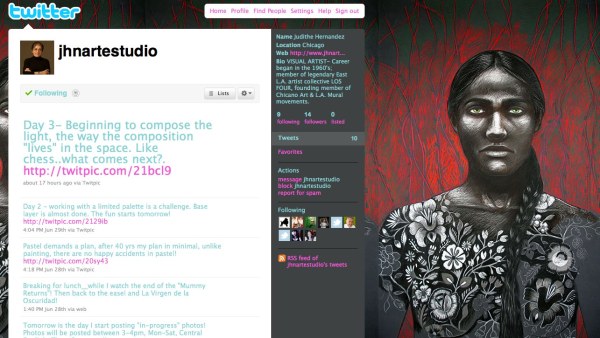
Featured Artist: Judithe Hernández
Follow artist Judithe Hernández and her works-in-progress at http://twitter.com/jhnartestudio
Hernández was a member of the legendary East L.A. artist collective LOS FOUR, and founding member of Chicano Art & L.A. Mural movements… READ MORE
THE HARVEST trailer
Shine Global‘s second feature documentary, THE HARVEST, tells the story of the children who work to feed America. Unprotected by child labor laws, the 400,000 American children sacrifice their education, their childhood, and their lives to help their families survive. To learn more about the film, please visit http://www.shineglobal.org.


 Xican@ Poetry Daily